In This Guide
- What Are the Official Parallel Parking Test Rules in PA?
- PennDOT Parallel Parking Space Dimensions & Distance
- How Many Adjustments and Curb Touches Are Allowed in PA?
- Common Mistakes That Lead to an Automatic Failure in Bensalem
- How 1st Class Driving School Prepares Bristol Students to Pass
- Frequently Asked Questions
Quick Answer
Under the parallel parking test rules in PA, you must park your vehicle within a 24-foot by 8-foot space using no more than three adjustments (direction changes). Your vehicle must finish parallel to and within 18 inches of the curb without climbing the curb or striking any boundary cones.
Your Guide to PA Parallel Parking Test Rules: Pass in Bensalem & Bristol
On This Page:
- What Are the Official Parallel Parking Test Rules in PA?
- PennDOT Parallel Parking Space Dimensions & Distance
- How Many Adjustments and Curb Touches Are Allowed in PA?
- Common Mistakes That Lead to an Automatic Failure in Bensalem
- How 1st Class Driving School Prepares Bristol Students to Pass
- Frequently Asked Questions
What Are the Official Parallel Parking Test Rules in PA?
The official Pennsylvania parallel parking test rules require you to successfully back your vehicle into a designated space within three adjustments and without striking any boundary markers. This maneuver is the very first physical driving challenge you will face during your Class C non-commercial driver’s license exam. The official rules are governed by the Pennsylvania DMV (PennDOT) driver licensing standards, which require examiners to evaluate your spatial awareness, steering control, and observation skills before you are permitted to drive on public roadways.
When you arrive at the testing facility with your accompanying licensed driver, your examiner will first conduct a pre-trip vehicle safety inspection. They will verify your registration, insurance, and the functionality of your lights, signals, horn, and wipers. Once your vehicle passes this check, the examiner will direct you to the parallel parking lane. It is critical to understand that the parallel parking portion of the exam is a pass/fail gatekeeper. If you fail to complete the parking maneuver according to PennDOT standards, your test ends immediately, and you will not be allowed to proceed to the on-road driving portion of the exam.
Step-by-Step Guide to Perfect Parallel Parking
To master the reverse parallel parking steps, you must treat the maneuver as a series of precise, mechanical actions rather than a guessing game. Follow this proven sequence that we teach our students daily:
- Signal and Align: As you approach the parking space, activate your right turn signal to indicate your intention. Pull up alongside the simulated front vehicle (represented by the front set of cones) until your rear bumper is roughly aligned with the front cones. Maintain a lateral distance of approximately two feet between your vehicle and the cones.
- Shift and Scan: Shift your vehicle into Reverse. Before moving, perform a 360-degree sweep of your surroundings. Turn your head to look directly over your right shoulder through your rear window. Safe low-speed maneuvering guidelines are also emphasized by the NHTSA to prevent pedestrian accidents during backing maneuvers. Do not rely solely on your mirrors or backup camera.
- Establish the Pivot: Slowly ease off the brake and begin backing up while turning your steering wheel fully to the right. Continue at this slow, controlled speed until your vehicle is positioned at approximately a 45-degree angle relative to the curb. In your side mirror, you should see the rear-most cone closest to the curb.
- Straighten and Tuck: Straighten your steering wheel and continue backing straight. Once your front bumper clears the imaginary bumper of the front vehicle (or passes the front cones), turn your steering wheel fully to the left. This action swings the nose of your car into the space while the rear tucks neatly toward the curb.
- Center and Secure: Shift into Drive, straighten your wheels, and pull forward slowly to center your vehicle within the 24-foot space. Once your vehicle is parallel and centered, shift into Park, pull the emergency brake, and look at the examiner to signal that you are finished.
Pro Tip: The Rear-Window Reference Point
To know exactly when to turn your wheel fully to the left, look over your right shoulder. When the rear-right passenger window’s corner aligns with the first front cone, that is your cue to swing the steering wheel hard left. This reference point works for almost all standard sedans and mid-sized SUVs.
PennDOT Parallel Parking Space Dimensions & Distance
The standard PennDOT parallel parking space dimensions for the PA driving test are exactly 24 feet long and 8 feet wide, providing ample room for a standard passenger vehicle. Many new drivers experience anxiety when visualizing a parallel parking space, but the reality is that a 24-foot space is incredibly generous. For context, a standard mid-size sedan is roughly 15 to 16 feet long, which leaves you with nearly 8 to 9 feet of total clearance to split between your front and rear bumpers.
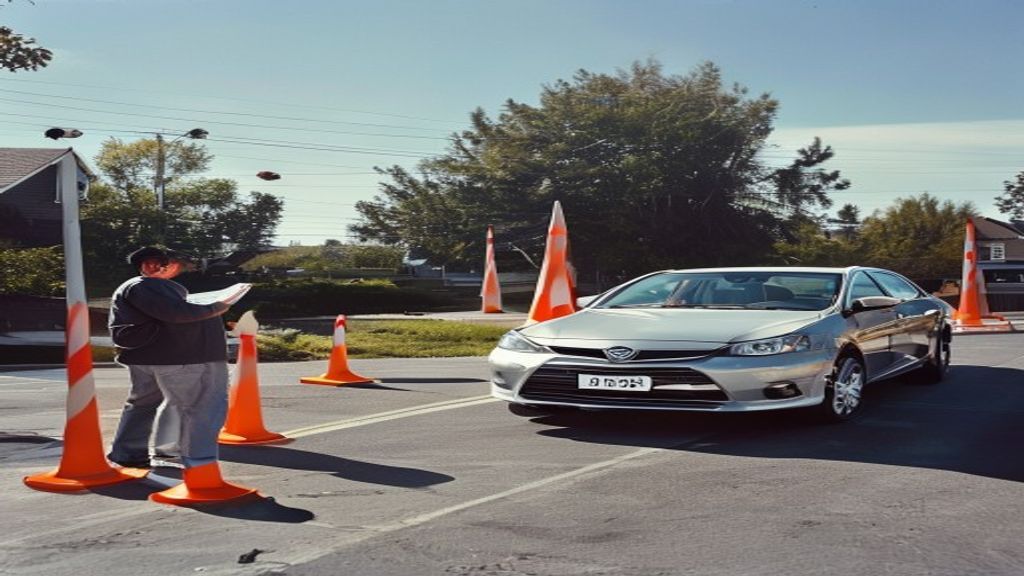
The space is demarcated by six orange traffic cones, often topped with vertical white poles to simulate the physical presence and height of real parked cars. The PA road test parallel parking distance from the curb is another critical metric: your vehicle must finish parallel to, and within 18 inches of, the curb or simulated curb line. If your vehicle is parked further than 18 inches from the curb, you will fail the maneuver. The examiner will step out of the vehicle and physically inspect this distance, visually measuring the gap between your passenger-side tires and the curb line.
| Maneuver Metric | Official PennDOT Standard | Allowable Margin / Limit | Impact on Test Result |
|---|---|---|---|
| Space Length | 24 Feet | Fixed dimensions | Standardized at all PA locations |
| Space Width | 8 Feet | Fixed dimensions | Standardized at all PA locations |
| Distance from Curb | Maximum 18 Inches | Must be parallel within 18″ | Failure if exceeded |
| Directional Adjustments | Maximum 3 Shifts | Up to 3 gear changes (R-D-R) | Automatic failure on 4th shift |
How Many Adjustments and Curb Touches Are Allowed in PA?
In Pennsylvania, you are allowed a maximum of three adjustments (shifting between reverse and drive) to successfully position your vehicle, and while light curb touches are permitted, climbing or hard-striking the curb results in an automatic failure. Understanding the difference between a minor point deduction and an immediate test termination is essential for managing your nerves during the exam.
Many students ask us, “how many attempts for parallel parking PA test do I get?” It is important to clarify terminology: you get one single “attempt” to park during your scheduled road test appointment. However, within that one attempt, you are permitted up to three “adjustments” or directional shifts. An adjustment is defined as any time you change your vehicle’s direction of travel by shifting gears. For example, your initial reverse into the space is adjustment number one. Shifting into Drive to pull forward and straighten out is adjustment number two. Shifting back into Reverse to tuck the rear end closer to the curb is adjustment number three. If you shift into Drive a fourth time to correct your position, the examiner will mark it as an automatic failure.
Another common point of confusion is how many curb touches are allowed in PA. If your passenger-side tire gently rubs or lightly taps the curb while you are backing up at a snail’s pace, this is generally scored as a minor error, resulting in a small point deduction. However, if your tire climbs up onto the curb, or if you strike the curb with enough velocity to cause the vehicle to shake or jolt, you will receive an automatic fail on the PA road test. The key is to keep your vehicle moving as slowly as possible—what we call “idle speed”—so that if you do make contact with the curb, it is a harmless touch rather than a test-ending impact.
Common Mistakes That Lead to an Automatic Failure in Bensalem
An automatic fail on the PA driving test during parallel parking occurs if you strike any of the boundary cones, mount the curb with any tire, or exceed the three-adjustment limit. While these rules are uniform across the state, local testing conditions can introduce unique challenges that catch unprepared drivers off guard.
During our decades of teaching, we have identified the most common errors that lead to automatic failures on the Pennsylvania parallel parking requirements:
- Striking a Cone: Hitting, knocking over, or even scraping any of the six boundary cones is an immediate disqualification. The cones represent real vehicles; hitting one means you would have caused property damage in a real-world scenario.
- Climbing the Curb: As mentioned, mounting the curb with any tire is an immediate failure. It indicates a complete lack of spatial control and presents a severe hazard to hypothetical pedestrians on the sidewalk.
- Exceeding the Adjustment Limit: Shifting gears four or more times to adjust your position will end your test.
- Unsafe Backing: If you fail to look out of your rear window while backing up, or if you rely exclusively on your backup camera, the examiner will terminate the test for unsafe operation. You must actively turn your head and scan.
- Failing to Use Turn Signals: Forgetting to signal your intention to park as you approach the space is a serious point deduction that, when combined with other minor errors, can lead to a failing score.
What to Expect at the Bensalem PennDOT Testing Center
For residents living in Bristol, Levittown, and surrounding areas, the Bensalem PennDOT center on Galloway Road is the primary testing hub. This location is notoriously busy, and the parallel parking setup is situated outdoors in a dedicated testing lane that can feel quite intimidating. The asphalt at the Bensalem site has seen significant wear, and the painted lines marking the 24-foot box can sometimes be faded, meaning you must rely heavily on your visual alignment with the cones themselves.
The examiners at Bensalem are highly experienced and strictly adhere to the PennDOT scoring rubric. They will stand outside the vehicle on the passenger side to closely watch your wheel angles, your distance from the curb, and any potential contact with the cones. Because of the high volume of tests conducted daily at this location, examiners expect students to perform the maneuver efficiently and safely without hesitation.
Pro Tip: Navigating Bensalem’s High-Pole Cones
The cones at the Bensalem testing center are fitted with tall, vertical white PVC pipes to represent the height of actual cars. Because these poles stand high, they can distort your depth perception if you look only at the tops of them. Always focus your eyes on the base of the cones where they meet the asphalt to accurately judge your distance.
How 1st Class Driving School Prepares Bristol Students to Pass
By simulating the exact dimensions and high-pressure environment of the Bensalem DMV, our instructors ensure students can park flawlessly on their very first attempt. At 1st Class Driving School (Apka Desi), we specialize in turning anxious permit holders into confident, licensed drivers through structured, personalized instruction.
“I was absolutely terrified of parallel parking and was sure I would fail at Bensalem. My instructor from 1st Class Driving School set up a mock parking space that matched the DMV’s layout exactly. By the time my test day arrived, I parked on my first try with inches to spare!”
— Sarah M., Bristol, PA
Our school is deeply integrated into the Bucks County community. We help students throughout the region pass their exams with confidence, backed by our professional driving instructors in Bucks County. We do not just teach you how to pass a test; we teach you the defensive driving habits that will keep you safe for a lifetime. To ensure you do not fail on technicalities, our behind-the-wheel road test preparation packages cover every detail of the PennDOT scoring sheet, including mirror adjustments, proper signaling, and steering techniques.
We understand that every student learns at a different pace. That is why we offer flexible scheduling, free door-to-door pickup in Bristol, and dual-controlled training vehicles that give our instructors complete safety control during your lessons. Ready to practice in a simulated testing environment? Contact us today to schedule a parallel parking lesson near Bristol and take the first step toward earning your Pennsylvania driver’s license with ease.
Frequently Asked Questions
Can you adjust your mirrors before parallel parking on the PA test?
Yes, you are permitted to adjust your passenger-side mirror downward to get a better view of the curb and your rear tire before beginning the maneuver. You must return the mirror to its proper driving position before pulling out of the parking space.
What happens if you knock over a cone during the PA parallel parking test?
Knocking over, striking, or even lightly brushing a boundary cone with any part of your vehicle’s bumper or body is classified as an immediate, automatic failure, resulting in the immediate termination of your exam.
How many total minutes do you have to complete parallel parking in PA?
While PennDOT does not enforce a strict, stopwatch-timed limit, you are expected to complete the maneuver in a reasonable, continuous flow, typically under two to three minutes. Excessive hesitation can lead to a failed attempt.
Is parallel parking required to pass the PA road test?
Yes, parallel parking is a mandatory component of the Class C Pennsylvania road test. Failing to complete it successfully means you cannot proceed to the on-road portion of the test.
Can I use a backup camera during the PA parallel parking test?
Yes, you are allowed to use a factory-installed backup camera, but you cannot use it as your primary viewing source. You must still demonstrate proper backing habits by actively turning your head and looking over your shoulder.
Explore More Driving Resources
Ready to Get Behind the Wheel?
Book your driving lesson online in seconds, or call our team today.