For the Pennsylvania Class C driver’s road test, the official parallel parking test dimensions require a space approximately 24 feet long and 8 feet wide, delineated by four traffic cones. This setup is designed to simulate a realistic parking scenario, challenging drivers to maneuver their vehicle efficiently within defined boundaries, ensuring they can safely park on public roads.
As a seasoned driving instructor with over 15 years of experience helping thousands of students pass their road tests, particularly here in the Phoenixville area, I understand the anxiety that often surrounds the parallel parking maneuver. It’s not just about fitting your car into a space; it’s about demonstrating control, judgment, and adherence to specific PennDOT guidelines. My goal at 1st Class Driving School (Apka Desi) is to demystify this critical part of the test, providing you with the precise knowledge and practical skills needed to pass with confidence. We offer driving lessons in Phoenixville and surrounding areas, tailored to prepare you for every aspect of the PA road test.
What are the Official PA Parallel Parking Test Dimensions?
The official Pennsylvania parallel parking test dimensions are crucial for anyone preparing for their Class C driver’s license road test.
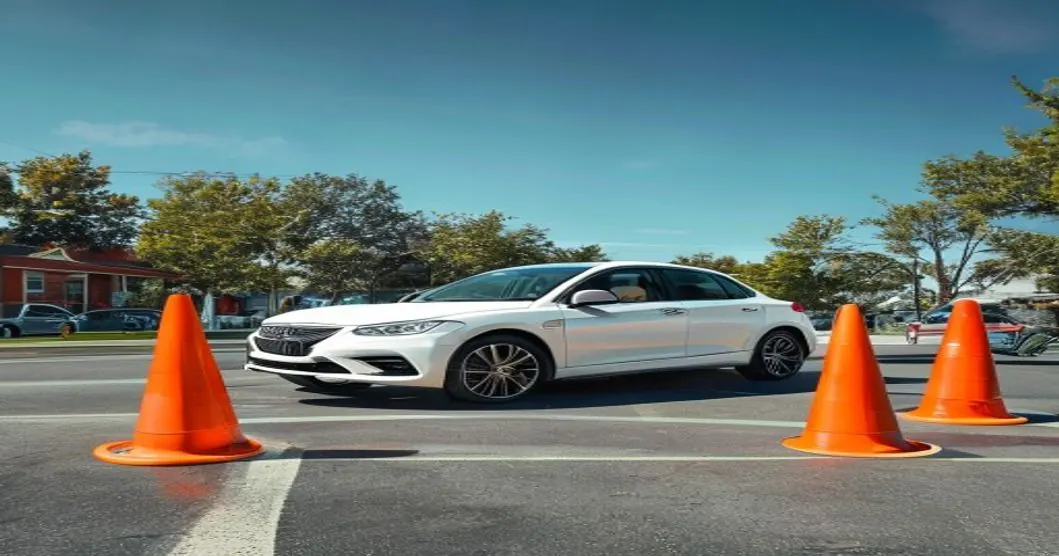
PennDOT specifies a practice area that is 24 feet long and 8 feet wide, marked by four traffic cones. This setup is designed to be slightly larger than a typical street parking space, providing a reasonable challenge without being overly restrictive. Two cones mark the front and rear of the ‘car’ you’re parking behind, and two more cones delineate the curb line. The goal is to park your vehicle completely within these boundaries, without touching any cones or exceeding the curb line.
Understanding the PennDOT Parallel Parking Setup
When you arrive for your road test at the local PennDOT Driver License Center, the parallel parking area will be clearly marked. The 24-foot length provides ample room for most standard sedans and smaller SUVs, while the 8-foot width ensures you have enough clearance from the ‘curb’ (represented by the cones). My students often ask if the dimensions change, but PennDOT maintains a consistent standard across all testing centers, including those serving our Phoenixville community.
- Length: Approximately 24 feet (about 1.5 times the length of an average car).
- Width: Approximately 8 feet (sufficient for typical passenger vehicles).
- Markers: Four traffic cones are used – two for the front and rear of the ‘parked car’ you’re maneuvering behind, and two to simulate the curb.
- Objective: To park your vehicle entirely within this designated area, parallel to the ‘curb’, without hitting any cones or crossing the boundary lines.
It’s important to remember that while the space is generous, precision is key. Understanding these specific `pa parallel parking test size` parameters is the first step towards developing an effective strategy for the test.
How is the Parallel Parking Test Scored in Pennsylvania?
The parallel parking test in Pennsylvania is scored based on a system of deductions for specific errors, with excessive mistakes resulting in an immediate failure.
During the PA road test, the examiner observes your ability to control the vehicle, judge distances, and follow proper parking procedures. Each error, such as touching a cone, crossing a boundary line, or requiring too many maneuvers, will result in a point deduction. While the exact point value for each mistake isn’t publicly itemized by PennDOT, the general rule is that repeated or significant errors will lead to a failure. For instance, hitting a cone or mounting the curb often results in an automatic fail, as these actions represent a significant safety risk in a real-world scenario.
Here’s a simplified breakdown of what examiners look for:
| Action/Criterion | Scoring Impact | Common Misconception |
|---|---|---|
| Touching Cones | Significant point deduction, often immediate failure. | “A light tap is okay.” (It’s not; any contact counts.) |
| Mounting/Touching Curb | Significant point deduction, often immediate failure. | “Just a little bump.” (Indicates lack of control.) |
| Exceeding Boundaries | Point deduction; vehicle must be fully within the 24x8ft space. | “As long as it’s mostly in.” (No, it must be entirely in.) |
| Excessive Maneuvers | Point deduction for too many forward/reverse adjustments. | “I can take as many tries as I need.” (Usually 2-3 attempts max.) |
| Parking Too Far from Curb | Point deduction; typically more than 6-12 inches from the ‘curb’. | “Better safe than sorry with distance.” (Too far is also a fail.) |
| Improper Signalling | Minor point deduction for not signaling when changing direction. | “Only need to signal on the street.” (Signals are for all maneuvers.) |
My coaching focuses on not just avoiding these errors, but on executing the maneuver smoothly and confidently. This often means practicing until the `parallel parking pass test` feels natural, almost second nature.
Expert Tips for Perfecting Your Parallel Parking Maneuver
Passing the `parallel parking driving test pa` requires a consistent approach and plenty of practice. Here are the core techniques I teach my students, proven effective for the `pa parallel parking test dimensions`:
- Initial Positioning: Pull up alongside the vehicle you intend to park behind (or the cones marking its position) so your rear bumper is even with its rear bumper. Maintain about 2-3 feet of lateral distance.
- First Reverse Angle: Turn your steering wheel all the way to the right (if parking on the right side of the road). Slowly reverse until you can see the far headlight of the car behind you (or the far rear cone) in your left side mirror.
- Straighten Out: Straighten your wheels (turn the wheel 1.5 times back to center). Continue backing slowly until your right front bumper aligns with the other car’s rear bumper (or the front cone of the space).
- Second Reverse Angle: Turn your steering wheel all the way to the left. Continue backing slowly, checking all mirrors and your blind spots, until your car is parallel to the curb and centered within the space.
- Final Adjustments: Once parallel, make small forward or backward adjustments to center your vehicle within the 24-foot space. Ensure you are no more than 6-12 inches from the curb.
Remember, the key is slow and controlled movements. Don’t rush! Many students fail not because they don’t know the steps, but because they execute them too quickly, losing control or misjudging distances. Practicing these `parallel parking techniques` repeatedly builds muscle memory and confidence.
What are the Common Mistakes to Avoid During the PA Parallel Parking Test?
Avoiding common pitfalls is as crucial as knowing the correct procedure for passing the PA parallel parking test.
From my experience, the most frequent errors my Phoenixville students make often involve spatial awareness and overcorrection. These include misjudging the 24-foot length and 8-foot width of the parking box, leading to hitting cones or parking too far from the curb. Another common mistake is failing to check mirrors and blind spots adequately, which indicates poor situational awareness to the examiner. Over-steering or under-steering at critical points also leads to needing excessive maneuvers, which can result in point deductions or failure.
- Hitting Cones: This is arguably the most common and often an automatic failure. It demonstrates a lack of control and spatial judgment within the `pa parallel parking test parameters`.
- Mounting or Touching the Curb: Similar to hitting cones, this indicates poor vehicle control and can lead to immediate failure. Your vehicle must remain off the curb.
- Parking Too Far from the Curb: If your vehicle is more than 6-12 inches from the curb, it’s considered an unsafe park and will result in significant point deductions.
- Taking Too Many Attempts: While you’re allowed some adjustments, needing to pull forward and reverse multiple times (typically more than 2-3 significant adjustments) indicates inefficiency and will cost you points.
- Not Centering the Vehicle: Your car should be reasonably centered within the 24-foot space. Parking too far forward or backward, leaving a significant gap at one end, will be penalized.
- Forgetting to Signal: Even in a controlled test environment, proper signaling for turns and lane changes (or in this case, pulling over and backing up) is expected.
- Lack of Observation: Failing to check mirrors and blind spots demonstrates a lack of awareness, which is a critical safety concern.
I always emphasize to my students near Phoenixville that the test isn’t just about the outcome, but the process. A smooth, controlled, and observant execution of the `parallel parking distance pa test` is what the examiner is truly looking for.
How Can 1st Class Driving School Help You Master Parallel Parking?
1st Class Driving School (Apka Desi) offers specialized instruction designed to help you confidently master the PA parallel parking test and all other road test requirements.
We don’t just teach you the steps; we help you understand the dynamics of your vehicle within the `pa parallel parking test dimensions`. Our experienced instructors provide personalized, one-on-one coaching, breaking down the maneuver into manageable steps and offering immediate feedback. We practice in environments that closely simulate the actual PennDOT testing conditions, including the precise 24×8 foot cone setup. This hands-on, targeted approach is why so many of our students from Phoenixville and surrounding communities successfully pass their road tests.
- Personalized Instruction: Our instructors adapt to your learning style and pace, focusing on your specific weaknesses.
- Simulated Test Environment: We set up the exact `parallel parking test parameters` with cones, so you get realistic practice.
- Strategic Guidance: We teach you visual reference points unique to your vehicle, making the maneuver intuitive.
- Error Correction: We identify and correct common mistakes before they become habits, ensuring you avoid point deductions.
- Confidence Building: Consistent practice under expert supervision builds the confidence needed to perform under pressure on test day.
Our dedicated parallel parking mastery lessons are specifically tailored to address the challenges of this maneuver, ensuring you’re fully prepared. We also offer comprehensive driving lesson packages that cover all aspects of the PA road test, from basic vehicle control to advanced defensive driving techniques.
Ready to Ace Your Phoenixville Parallel Parking Test?
Passing your PA road test, especially the parallel parking component, is a significant milestone towards gaining your independence and becoming a safe, licensed driver.
With a clear understanding of the `parallel parking test rules pa`, dedicated practice, and expert guidance, you can approach your test day with confidence. At 1st Class Driving School, we are committed to providing the highest quality instruction to drivers in Phoenixville and beyond. Our proven methods, combined with your effort, will ensure you’re not just ready to pass the test, but ready to drive safely for years to come. Don’t let parallel parking be a roadblock on your journey to getting your driver’s license. For more official information, you can always refer to the Pennsylvania DMV (PennDOT) official site. For general road safety, I also recommend reviewing NHTSA road safety guidelines.
We are here to help you navigate every turn, including the often-dreaded parallel parking maneuver. Let us equip you with the skills and confidence to ace your `pa parallel parking test dimensions` challenge.
Ready to get started? Book your parallel parking lesson with 1st Class Driving School today and take the first step towards your Pennsylvania driver’s license!
Frequently Asked Questions
Here are some of the most common questions my students ask about the PA parallel parking test:
What are the exact dimensions for the parallel parking space on the PA driving test?
The official PennDOT parallel parking space dimensions are approximately 24 feet long and 8 feet wide. This area is clearly marked by four traffic cones, simulating a parking spot between two parked vehicles and a curb. Understanding these precise measurements is fundamental for effective practice and successful execution on test day.
How many attempts do you get for parallel parking during the PA road test?
PennDOT does not specify an exact number of “attempts” in the sense of starting over. You are generally expected to complete the maneuver within two to three forward and reverse adjustments. Excessive maneuvering or repeated failures to get into the space will result in point deductions or a failing grade for that section.
What happens if you touch a cone or curb during the PA parallel parking test?
Touching a cone or mounting/touching the curb during the PA parallel parking test typically results in a significant point deduction, and often an immediate failure of the road test. These actions demonstrate a lack of vehicle control and spatial judgment, which are critical safety concerns for examiners.
Is parallel parking required for the PA senior driver‘s test?
No, parallel parking is generally not a required maneuver for the PA senior driver’s test, which is typically a vision screening and a review of driving records. The parallel parking component is specifically for new drivers seeking their initial Class C driver’s license, not for license renewal for experienced drivers.
How can I practice parallel parking effectively before my PA road test in Phoenixville?
To practice effectively in Phoenixville, find a safe, empty parking lot (like a large school or church lot on weekends). Use four cones or even empty boxes to mark out the 24-foot by 8-foot space accurately. Practice the step-by-step technique slowly and repeatedly, focusing on precise steering and observation. Professional lessons from 1st Class Driving School offer supervised, targeted practice.
Are there any other maneuvers besides parallel parking on the PA road test?
Yes, in addition to parallel parking, the PA road test typically includes other maneuvers such as the three-point turn (K-turn), proper stopping at intersections, navigating turns, lane changes, and demonstrating general safe driving practices like observation, signaling, and maintaining appropriate speed and following distance. Parallel parking is just one component.
Ready to Get Behind the Wheel?
Join hundreds of confident drivers trained across Phoenixville. Flexible scheduling, patient instructors, real results.